Thursday, June 2, 2016

Parental Involvement more than doubled in a middle school!

Written parental dreams for a child can become a treasured possession. Sadly for the years since 2009 when a project to get such letters from parents started, a 30% response rate was about the best achieved. Now that has changed to over 80%! 

The process of discussing these goals within the heritage of the family, and updating those dreams over time, changes lives. The world becomes a very different place, especially in middle school and high school.

The School Time-Capsule Project started in 2005.  Then it was only focused on students writing letters to themselves at the end of 8th grade.  Since 2009 the project has encouraged parents, and/or important relatives, to write letters to their student about their dreams for them. Such potentially priceless letters have rarely been written for more than 30% of students. A copied request for this letter sent home with students has not been very effective in getting parents to write. 

A new approach was started in 2016. 


First, instead of being only an 8th grade exercise the letter writing was expanded to be done by all students in Quintanilla, all three grades. 
Second, students themselves wrote a personal letter to their parents asking for a letter back about their dreams for them. 

The results have been dramatic. As many as 85% of students have now received one or more such priceless letters back, almost a 200% increase! 

The letter may not be written in English, but that makes no difference!  It is priceless.

Students also ask for one story from their family history to be included in the letter, a story the writer of the letter wants them to remember 30 years into the future, an important piece of their family heritage and history.

The resulting letters should be immediately shared with and studied by the students at home so any questions can be answered.  That often leads to valuable discussions at home.

Then the letters are all brought to school and used in Language Arts Class as students write letters to themselves about their own plans for the future.


Parents and/or relatives should be prepared to write such letters to their child every year from 6th through 12th grade, until their child graduates from high school. 

A child changes greatly in just one year.  Each letter will be different, with a different story from their family history.  The more a child knows about their family history, both painful stories and wonderfully positive stories, the better.  It all helps ground a child in a valuable personal heritage providing a solid foundation for life, and for school work. 

A written record is being created.


All the letters for each child (more than one relative can write a letter) would be placed into one self-addressed envelope for each student, along with the student's own letter to themselves, and then stored in the school time-capsule, a 500-pound vault bolted to the floor in a prominent place in the school lobby.

The vault is not necessary if teachers have other ways of storing such priceless letters. 

If parents immediately see how priceless these letters are, they can certainly ask to keep the letter at home and only send photocopies to school to place inside the time-capsule. Or a photo copy can be kept at home.  Such requests are certainly understandable regarding all these letters. 


Each year the letters from the previous year are returned to the child and family for use in preparing to write new letters. That changes with the 8th grade letters that are written with plans for 10 years into the future. The 8th grade letters remain in the time-capsule for a decade. 


A student can also choose to collect all three years of letters for placement into the final envelope that is kept secure in the vault for a decade.  It is a potentially powerful record of their middle school years.

Students must know that upon their return to get back their letters in 10 years they will also be invited to speak with current students about their recommendations for success.  Such priceless mentoring has already started at Quintanilla Middle School with the reunion of the Class of 2006.  It will now be an annual event, making the future ever more real for Quintanilla students. Achievement at Quintanilla should continue to improve.


In high school the annual letter writing pattern continues.  The final 12th grade letter will also be planning for 10 years into the future. 

Imagine how powerful high school 10-year reunions will be as students read their letters, and their parents letters, once again.  Most important, imagine the power of what these former students can say to students sitting in the same seats they were in a decade earlier!

These are the plans working within the School Time-Capsule Project as of June of 2016. We have just completed the second 10-year reunion at Quintanilla Middle School.

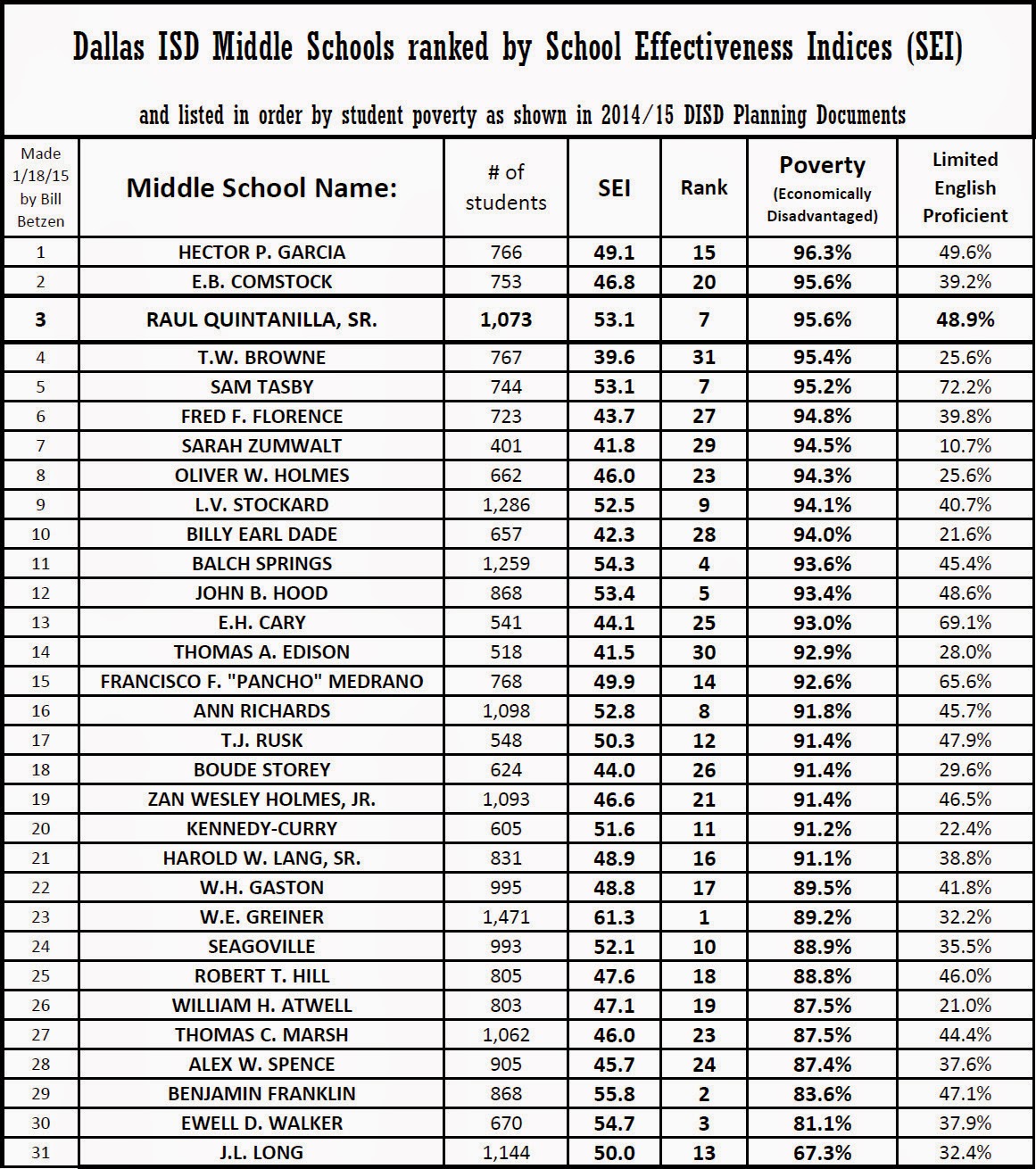
Graduation rates for Quintanilla students have more than doubled and continue to rise.  Behavior problems are down and pregnancy rates are down. The most recent School Effectiveness Index (SEI) for Quintanilla is the highest of all 35 middle schools in Dallas ISD!  The chart below was made from the listing of all SEI scores for middle schools in DISD found in the DISD Data Portal at 
https://mydata.dallasisd.org/docs/SEI/SEI1415/201415_SEI_REPORT_LIST_no_div.pdf  
School Effectiveness Indices (SEI) details and history are online at https://mydata.dallasisd.org/SL/SD/SEI/Default.jsp 
These achievements happened in spite of the 96 percent poverty rate for Quintanilla students, which places Quintanilla within the most poverty stricken third of all middle schools in Dallas ISD!  In addition, discipline problems and pregnancy rates at Quintanilla have dropped dramatically since 2006.  The best birth control is active personal planning for the future!

Again, this year was the first year that all students wrote letters for the Quintanilla Time-Capsule.  It used to be only an 8th grade activity, but Quintanilla wants to raise their record SEI score even higher than the 59.3 in the above chart.  This change will intensify the focus on a future grounded in family heritage for all students in all grades.  With the return of the previous year's letters it should help lead to improved letter writing and planning in the 7th and 8th grades.  

Quintanilla will stay on top with the highest SEI, unless other middle schools begin to also have a more effective future focus with all of their students, the best competition possible for Dallas ISD students!

Actively planning for their futures, in active cooperation with parents and relatives sharing family heritage and dreams with them, will continue to help students of poverty achieve more like, and in some cases certainly better than, middle class students from any Dallas suburb! The progress must continue.

Monday, May 9, 2016

Helping Urban Children of Poverty achieve like Suburban Middle Class Kids

The power of expressed and documented parental dreams for a child cannot be over-estimated. The book "Dreams from my Father" by President Obama is only one example.  

The School Time-Capsule Project has worked since 2009 to encourage parents to write such priceless letters to their child.  The response has rarely been higher than 30%.  Now a new approach is being used.  We are now asking students to write a personal letter to their parents asking for such a letter back to them. Instructions are attached to the student's request.

This major improvement to the School Time-Capsule Project was the idea of Ms. Kiki Lincoln, the Language Arts Coach at Quintanilla Middle School. She described it to me yesterday!  This is a big improvement!

Imagine that these 6th graders also ask their parents to include in that potentially priceless letter one story from their family history.  It should be a story that their parents want them to remember 30 years into the future, an important piece of their family story.

With such a personal request in a letter from their own child many parents will respond.  

The resulting parental letter would then be studied by the child, often leading to discussions with their parents. That letter would be brought to school and used in Language Arts Class as students write letters to themselves about their own plans for the future.

Parents should be prepared to write such letters to their child every year from 6th through 12th grade, until their child graduates from high school.  

A child changes a lot in just one year.  Each letter will be different, with a different story from their family history.  The more a child knows about their family history, both painful stories and wonderfully positive stories, the better.  It all helps ground a child in a valuable history providing a valuable foundation for life. 

A written record is being created.

All the letters would be placed into one self-addressed envelope for each student and then stored in the school time-capsule, a 500-pound vault bolted to the floor in a prominent place in the school lobby.  

If parents immediately see how priceless these letters are, they can certainly ask for photocopies of them to keep, or to place inside the time-capsule so that the originals can be kept at home.  That is certainly understandable, and encouraged if requested. 

Each year the letters from the previous year would be returned to the child and parents for use in preparing to write the new letters.  That only changes with the 8th grade letter that is written with plans for 10 years into the future.  The 8th grade letters will remain in the time-capsule for a decade.  

Students must also know that upon their return to get back their letters, 10 years after the 8th grade, they will also be invited to speak with current students about their recommendations for success.  Such priceless mentoring has already started at Quintanilla with the reunion of the Class of 2006 to retrieve the letters they wrote a decade ago.  It will now be an annual event, making the future ever more real for Quintanilla students.

In high school the annual letter writing pattern continues.  The final 12th grade letter will also be planning for 10 years into the future. 

Imagine how powerful those high school 10-year reunions will be as students read their letters, and their parents letters, once again.  Most important, imagine the power of what these former students can say to students sitting in the same seats they were in a decade earlier!

These are the plans working within the School Time-Capsule Project as of May of 2016. We have just completed the second 10-year reunion at Quintanilla Middle School.

Graduation rates for Quintanilla students have more than doubled and continue to rise. The most recent School Effectiveness Index (SEI) for Quintanilla is the highest of all 35 middle schools in Dallas ISD!

These achievements are all in spite of the 96 percent poverty rate for Quintanilla students which remains!  In addition, discipline problems and pregnancy rates at Quintanilla have dropped dramatically since 2006.  The best birth control is active personal planning for the future!

This year is the first year that all Quintanilla students will be writing letters.  It used to be only an 8th grade activity, but Quintanilla wants to raise their record SEI score even higher than the 59.3 in the above chart.  This change will intensify the focus on the future for all students.  Quintanilla will stay on top, unless other schools begin to have a more effective future focus with all of their students, the best competition possible for DISD students!

Actively planning for their futures, in cooperation with their parents, will continue to help students of poverty to achieve more like, and in some cases certainly better than, middle class students from any Dallas suburb!  The progress must continue!

Saturday, April 16, 2016

Quintanilla Time Capsule Reunion #2 & Progress!

This Friday, 4-22-16, in the early morning, over lunch, and after school, the letters the 8th grade Quintanilla Class of 2006 wrote to themselves will be returned.  Members of this class can come to Quintanilla from 7:30 to 9:30, or over lunch from 11:30 to 1:30, or after school from 4:00 to 6:00 p.m. to pick up their letter.  They must bring their ID to pick up their letter from ten years ago. Hopefully the alumni from 2006 have already received a letter with these details.

========================================================
Here is a link to the newspaper coverage of the above event that went very well: http://educationblog.dallasnews.com/2016/04/time-capsule-reveals-hopes-and-dreams-in-a-dallas-school.html/#commentsOuterWrapper
========================================================

Quintanilla achieved the status of the highest-performing middle school in all of Dallas last year with an SEI score (School Effectiveness Indices Score) of 59.3, the highest in the district! Quintanilla is a Dallas ISD middle school that has one of the highest 10 poverty levels of all 32 middle schools in Dallas ISD. The Quintanilla SEI was also higher than any of the 5 middle schools that are magnet schools.
School Effectiveness Indices for the past 2 years for 32 Dallas ISD Middle Schools 
Quintanilla has many of the same programs as other middle schools in Dallas ISD except for one program that has been only happening at Quintanilla for the past 12 years. That is the School Archive Project, or as it is now more frequently called, the Time Capsule Project.

This is the second year Quintanilla has had reunions of students who were in the 8th grade at Quintanilla 10 years earlier and wrote letters for the vault bolted to the floor in the school lobby. Having these students return is making the project more real for current students. They are realizing more that the future will be here and their letters really will be returned to them in 10 years. What they do now will make the difference for their future!

This year for the first time these returning students from a decade ago will be invited to volunteer to speak with current Quintanilla students on Career Day on May 2nd!  A priceless set of messages will be delivered about the decade after 8th grade.

Beginning in 2009 the first of 7 other middle schools in DISD with time-capsule projects will begin their own patterns of annual 10-year reunions for classes who have been writing letters since their schools' time-capsule projects started. These schools will all see hopefully similar achievement gains from an ever stronger student focus on their own future.

The photo on the left is of the Quintanilla Time-Capsule contents. It shows the 2015 shelf with the new letters from the 8th grade class of 2015 after the letters from 2005 were removed to return to the Class of 2005.  The letters from 2006 are still in the vault waiting to be returned to the 8th grade class of 2006 beginning on 4-22-16.

In the constant effort to continue to raise achievement, Quintanilla is now planning to request that all Quintanilla parents this May write letters to their student about their parental dreams for their student, and to begin an annual pattern of such letter writing.  A child changes a lot in one year.

In each of these letters we will also be asking each parent to tell one story from their family history that they want their child to remember when they are 40 years old.  What can be more valuable than to reinforce connections to a child's personal family history, along with parental dreams?

All Quintanilla students will then bring these priceless letters to their Language Arts Classes after STAAR testing.  They will use them to write a letter to themselves about their own plans for their future, and how they will achieve those goals.  Then all the letters for each student will be placed in one self-addressed envelope for each student and placed into the vault.  The 6th and 7th grade students will have their letters collected for the vault.  The 8th grade students will be writing the letter for 10-years into the future and will place their letter into the vault themselves after the normal annual photos are taken.

Next year the same process will be repeated at the end of the year except that 7th graders will receive back their 6th grade letters, and 8th graders will receive back their 7th grade letters.  The goal is to constantly write better, more complete plans for the future as the normal changes in life happen.  Parents will also be asked to write new letters each year as they observe their child's changes year to year.

With this process the achievement level at Quintanilla will continue to rise if all other factors in the school remain positive.

Sunday, May 17, 2015

First Annual Quintanilla Time-Capsule Opening & Class Reunion

On 5-16-2015 Quintanilla began their annual Time-Capsule opening with the reunion of the Class of 2005.  It was a good day for many reasons. The students made the party significant. Many staff from Quintanilla in 2005 were present to celebrate with their former students. It was a great day!  Dozens of letters were returned to the students who wrote them a decade ago.

The letters that remain may be located in the Quintanilla Library. Call Quintanilla and ask for the library to verify if your letter is there: 972-502-3200.

Sadly only 2/3 of the 536 students in the 8th grade in 2005 wrote letters so there is not one for everyone.  2005 was the first year.  The time-capsule system was just being created.  The Quintanilla Vault was installed the summer of 2005. Since then over 95% of 8th graders have written letters each year as they left Quintanilla for high school.  Graduation rates have doubled and many other positive changes have happened.


First Annual Quintanilla Time-Capsule Opening
Reunion for Class of 2005

The value of focusing middle school students onto their own futures, by simply having a system where they can do the planning for that future in letters to themselves, is infinite!  The more we do it, and the more we get parents involved writing their own letters to their child each year as to their evolving dreams for their child, the more progress we will see in our schools.   Our children must take control of their own lives with the active support of their parents.  We must help that happen.  They must be able to look back and see the changes, see the good, and see how they can change things.

Then they need to share what they have learned with decade younger students back at their old middle school.   See www.studentmotivation.org.   A community of change is evolving in our neighborhood!

Ultimately each child must realize that they are responsible themselves for what happens.  Nobody can do it for them.

Sunday, January 18, 2015

How Dallas ISD Middle Schools are doing 1-18-15

Below is a just completed report about DISD Middle Schools, listed in order by student poverty from the highest poverty level schools to the least, with the ranking by School Effectiveness Indices and the percentage of limited English proficiency students also given.

Look at the schools with the highest poverty and highest LEP percentages who are also doing the best with the highest SEI scores.

The two middle schools with the most actively used School Time Capsule Projects for the most years are Quintanilla Middle School since 2005 and Greiner Middle School since 2009.  Student performance improves as students more actively focus on their own futures.  Actively planning for the future is one of the most powerful factors helping to overcome hindrances associated with poverty and limited English proficiency.  It is one part of a complex system needed for our students to embrace high expectations for themselves and excel!

I welcome questions.   bbetzen@aol.com


Notice that only two schools have higher poverty rates that Quintanilla and only 4 have higher LEP percentages.


Monday, January 12, 2015

Improving Dallas ISD: Four Changes - 1-12-15

Four changes would massively improve Dallas ISD to the benefit of our entire city:

1) transparency, to drive and monitor all other changes,
2) parental Involvement to affirm and drive goals,
3) more developmentally appropriate grade configurations with k-8 schools, and
4) public discussions regarding the research surrounding planned changes within DISD, before the changes.

All four steps are present now inside DISD to some extent, but three of the four, transparency, parental involvement, and dedication to research, conflict with what appears to be the emerging administrative philosophy in DISD. 

The only progress is in the area of developmentally appropriate grade configuration, but it is far too little as k-8 schools are developing exceptionally slowly.  That progress is ONLY due to parents who are getting actively involved in long term planning and not waiting for an invitation from DISD administration. 

Here are details about the four changes needed.


1) Transparency

The old cowboy insult of “all hat and no cattle” is an all too accurate description of educational history in Texas. In 2000 such bragging became so bold that Houston actually claimed "zero dropout rates."  The Houston reality was that far less than 50% of any 9th grade enrollment were receiving diplomas within 4 years.  The dropout rate was very far from zero, thus "no cattle!"

While many school districts are slowly moving away from such “all hat and no cattle” claims, TEA recently made some of the boldest "all hat and no cattle" claims in the history of school accountability in Texas!  TEA claimed current graduation rates that amounted to placing Texas among the group of states having the 4th highest graduation rates in the nation!  Fortunately business leaders in Texas, as well as academic leaders, were vigilant and publically challenged TEA on these misleading and less than truthful graduation rates.

The Texas education system in general is now ranked as 39th in the nation according to reports made this week.  The Texas Legislature has no influence over such rankings as they do over the TEA.

In spite of what TEA is trying to do, absolute transparency is slowly being understood as the best alternative. Texas has led the way with the raw data about our schools and our students being placed online and annually updated at http://ritter.tea.state.tx.us/adhocrpt/Standard_Reports.html.  Almost all the reports posted in this blog come from that web site.

With more such transparency Dallas was making more very real progress through 2012 than at any time in the past 20 years!  Then the progress stopped. Admitting and sharing the painful truths in our public schools is the only way to have a strong foundation for progress.

The most accurate, easy to audit measurements for a credible transparency are the number of students who enroll each year in each grade, combined with the number who graduate annually, and how many of those annual graduates are ready for college. Simple spreadsheets for each school and school district should include enrollment by grade and year, covering 10 years or more of such annual enrollments.  Each year’s numbers should include graduation numbers and percentages of those graduates who are college ready.  It would quickly show if progress is happening.

The Internet allows the accumulation and availability of such data to explode. Dallas ISD is constantly taking advantage of that availability with results that are improving, and constantly need to improve. DISD does not yet have such a multi-year spreadsheet online and in a prominent place on the DISD web site.  Such a spreadsheet could look like this chart: 
In such a spreadsheet cells for the measurements could be colored gray, like those above, when measurements are getting worse, and left clear when there is progress.  See how clearly the 5 years of record progress are outlined above.

Such a prominent spreadsheet on the DISD web site would make Dallas a national leader in educational transparency. No other major US City has such longitudinal, multi-year, transparency. Dallas ISD can lead the way!

Such a lack of more complete transparency also hides good news.

Significantly positive changes within DISD started in 2007, but received no publicity. Those positive changes happened when the 9th grade bubble began to disappear. The 9th grade bubble is caused when the 9th grade is larger than the 8th grade the year before. That is caused by large numbers of 9th grade students failing and repeating the 9th grade. Too many middle school students were not prepared for the 9th grade. As they fail the 9th grade enrollment grows due to students repeating the 9th grade two or more times.

From 1996 through 2006 the average 9th grade enrollment in Dallas ISD was 33% larger than the 8th grade enrollment due to such failures. For the decade between 1996/1997 to 2005/2006 the average 8th grade enrollment was just over 11,025, and the average 9th grade enrollment was 14,727. 
That 33% 9th grade bubble began to disappear in 2006.   The difference between the 8th and 9th grade enrollment had dropped to only 8.5% for the Class of 2012.  Sadly some of that progress has been lost and now for the Class of 2014 that difference is up again to 10%, still much better than 33%, but a step back.

The 9th grade shrinking means more students began passing on to the 10th grade. Upper grade enrollment broke records and finally the Class of 2013 was the largest graduation class for DISD since 1981 with the highest percentage of 9th grade enrollment represented in the graduation class since 1984!  (See enrollment by grade numbers going back to 1996/97 in the chart above. )
Good things were happening in DISD!   We must go back to the progress that led to the Class of 2013.  Sadly the Class of 2014 was over 400 students smaller than the Class of 2013, the first drop in senior graduation class size in 7 years and the greatest drop in decades!  We must return to the progress that was happening! More complete transparency will expose all sides of DISD, the good and the bad.
 

2) Parental Involvement!
Sunset High School Progress in Dallas ISD
Right-click on above image to enlarge and/or print.
Parental involvement is the foundation for any cultural change within DISD. A project that has evolved to center on parents was started several years ago in one Dallas ISD middle school. This School Archive Project started as a focus by students on their own futures in letters they write to themselves for a time-capsule. Then in 2009 the most critical component was added: letters by parents to their child about their own dreams for their child. It is reinforcing parental involvement as never before.

Now entering middle school students start the year receiving a letter from their parents about their parental dreams for them in life. Yes, those dreams include education. These new students bring these letters to their Language Arts Class. They spend a week writing a letter to themselves about their own history and goals for themselves in middle school. Then both letters are placed into a self-addressed envelope and into the 500-pound vault bolted to the floor in the school lobby.

This vault is in a prominent place and under spotlights. Students pass it several times a day. At times they may be reminded of what their parent's letter says that is inside the vault. Imagine the conversations that the writing of these letters may have provoked between parent and child. This helps to make such priceless, private conversations more common. It documents them and saves them for history.

The last month of middle school this almost three year old letter is returned to students and to their parents. Everyone sees how things have changed since these letters were written. Parents and students write new letters, this time looking 10-years into the future. This time the letters are placed into the vault for the next decade. Photos are made on the day the letters are placed into the vault. Students and parents receive copies of those photos with details on the back for the 10-year class reunion. Everyone is reminded that at that 10-year reunion the returning students will be asked to speak with decade younger students in the school about their recommendations for success. They are warned to prepare for questions such as "What would you do differently if you were 13 again?"

This School Archive Project started in 2005. The graduation rate for Sunset High School, Class of 2006, was below 33%. Sunset received most of these students. Their graduation rate slowly started to rise due to this project, and many other positive changes in the high school including a dynamic principal. In 2009 they installed their own vault at Sunset, and that same year the other middle school feeding into Sunset installed their own vault. The graduation rate for the Class of 2011 was 62%. It is expected to be near 66% for the Class of 2012. It will probably be 70% or better for the Class of 2013. No other high school in Dallas has improved even half as many percentage points over the same period as Sunset!

The many changes at Sunset made a very real difference. But Sunset is the only high school that has almost all incoming students already exposed to the School Archive Project before they arrive, and ready to do it again. That difference may be what has helped to make 
Sunset the most improved graduation rate high school in all of DISD for the past decade.It is the power of personal letters focused on history and the future, placed in a secure location of respect usually reserved for diamonds, gold, and money. It's a message about the value of history, the passage of time, hard work, and planning for the future.  See http://www.studentmotivation.org/ .

The value of the mentoring component is yet to be realized when the 10-year reunions start in November of 2014. The reunions will add to the cultural change. They may evolve into the largest single contributor to an ongoing, educationally focused, cultural change. The message former students bring back to decade younger students may become the most priceless factor in the improvement of our schools.

What would you do differently if you were 13 again?

This project starts with parents documenting their dreams for their children. This then helps their children, our students, to then focus on a more realistic future in a way that is easier to embrace, and change as needed. Such conversations need to be more common by parents and children.

3) Developmentally Appropriate Grade Configuration: change to k-8 schools
(Yes, close all middle schools!)

Debates over grade configurations surrounding middle school have gone on for as long as middle schools have existed. Research has now pushed that issue well beyond the debate stage.

July 2011 Harvard University study has emphasized the urgency of an improvement for our public schools that parents need to study. This detailed and extensive research concluded (page 23): "Taken as a whole, these results suggest that structural school transitions lower student achievement but that middle schools in particular have adverse consequences for American students." If parents agree, they must demand changes in grade configuration, especially here in Dallas due to the publicly acknowledged issues with our DISD middle schools.

The Harvard study showed that in virtually all subjects the scores on standardized test were lower in middle schools than in K-8 elementary schools. Parents and teachers familiar with both settings will rarely be surprised by these findings.

This past November a 
powerful editorial was published by CNN giving a simple message: "By all accounts, middle schools are a weak link in the chain of public education."

The K-8 response to this "weak link" is gaining momentum. The number of  K-8 schools has almost doubled in the US since 2000 as over 1,000 middle schools have disappeared, or been re-purposed as K-8. Google news for K-8 and middle school.  You will find reports of school districts closing middle schools and changing them to K-8 elementary schools with very few exceptions. The reason is as simple as the statement a decade ago by William Moloney, then the Education Commissioner of Colorado: "K-8s are the place where everybody knows your name."

What better place to endure the uncertainties of puberty? Instead DISD is now forcing students entering the changes of puberty to move to a strange school with hundreds of other students from other schools also struggling to regain their self image as they change. It is no wonder that we have behavioral issues! Student performance then falls in DISD middle schools.

This past April the National Middle School Association changed its name to the 
Association for Middle Level Education. They saw middle schools being closed in the US, and realized such separate institutions do not exist in the highest achieving school systems in the world, such as Finland. In such countries the elimination of the middle school transfer trauma appears to help in far exceeding US academic achievement while at the same time investing significantly fewer classroom hours. The name change reflected a more authentic focus on educating students ages 10 to 15. Will Texas public schools see what is happening? (See more links to articles on this issue here.)

Parents can study these factors and be the driving force behind helping DISD to slowly move to k-8 schools system wide That process has already happened in one school, Rosemont Elementary in DISD, which is leading the way. Parents studied the issues and demanded the change. More schools will follow as quickly as parents can study the issues and continue to demand the change.

Such change will also strengthen PTA memberships as parents will be with the same PTA for three more years. There will be more of an investment in each k-8 school. They must be the best schools for the sake of the neighborhood!

4) Visibility and open debate of research
 

DISD continues to reference selective research and supporting data in the changes they have been recommending for our schools, but that effort avoids much more research and data that point the other direction.  This must change.

When policy changes as large at TEI, the Teacher Excellence Initiative, are being designed and considered, there should be public meetings where the research pointing both ways can be presented and discussed.  It must be a public debate well beyond the level of 3x5 cards.
Currently even the Gates Foundation, on whose research much of TEI is based, is now recommending that any usage of testing of students in teacher evaluations be placed on hold.  Can DISD ignore that request?  A more public dialogue on the research is needed.

**************************************
As to costs for these four changes, only the one for a movement to k-8 configurations would involve significant costs due to potential building modifications. This k-8 change process could happen as quickly as parental groups form and request such changes.  It could be worked into the normal building budget for DISD. Also, since Dallas County has seen a constant drop in birth numbers since 2007 there may not be the normal pressure for building new schools.  Such k-8 transitions could happen more easily.  Otherwise, especially by ignoring patterns present in national research, DISD could lose millions of dollars in multiple areas in addition to the loss of potential student achievement.

These four ongoing changes within Dallas ISD, if accelerated and reinforced, will create a high preforming urban public school system, a national model!

Thursday, December 11, 2014

A 20 year old letter writing project in a high school in Canada.

Here is a wonderful video about a teacher with another letter writing project now over 20 years old in Canada.   See https://www.youtube.com/watch?v=oeX1H7ajOvQ

It shows the potential power of the letters our students are writing to themselves.